Skip to Main Content

Time to Get to Work

A quick scan of this morning’s Guardian:  Osborne’s austerity plan still failing spectacularly, youth unemployment hits one million, British manufacturing has shrunk by two thirds in 30 years.  I’m reminded of an old political slogan:

“It’s the economy, stupid.” 

trickling downThat line helped Bill Clinton get elected twenty years ago. It’s just the kind of blunt statement of the obvious that appeals to the American style of consciousness. But it’s also fitting in this moment of history and for reasons beyond the superficially obvious. It’s full of historical irony, standing for both an assumption of the primacy of material growth culture, and the economic bribery that is the dominant calculus of governance, as true in the West as in post-Tiananmen China. Its snarky tone reflects the skewed power relation between the ruling elite and the stupid masses whom they cynically pacify with “trickle down” theories. A power relation that, in the wake of Occupy, may eventually be turned on its head, in which case “it’s the economy, stupid” could join “let them eat cake” in the double irony Hall of Fame. We can hope, but there is yet much more work to be done.

And this is exactly what Transition is for, isn’t it? Doing the work? With a little study, it’s not hard to begin to understand the root of the problem, at least the broad outlines. There’s a mountain of good analysis and theory describing historical processes and consequences of globalised corporate capitalism – mass resource extraction, mass manufacturing, mass advertising, mass debt, mass consumerism, etc. In short, corporations have too much political power and too much economic power, which is, more or less, destroying democracy and the biosphere. 

Understanding the linkages in one’s own community is vital. There’s almost as much good analysis and theory describing positive, workable solutions, especially at the local level. In short, communities can become more sustainable and resilient to the extent they can unplug from the globalised corporate system, satisfying needs and wants from green and local alternatives. 

carboard house, not powered by oilIn Shaun Chamberlin’s opening post on Sunday, he draws a parallel between Transition and Occupy. They both are raising awareness and leading by example. Occupy is shining a bright light on the corrupt and rapacious financial/ruling elite. Occupy self governs with transparency, inclusive and consensus decisionmaking, running their camps like equitable little democracies, teaching by modelling appropriate behaviours. 

Transition has been doing much the same, setting up alternative structures and modelling new ways of working together. As a result, where you find successful Transition initiatives, you find growing stores of alternative capital – social and community – and raised awareness that, yes, energy and ecological limits impose real limits to a growth economy.

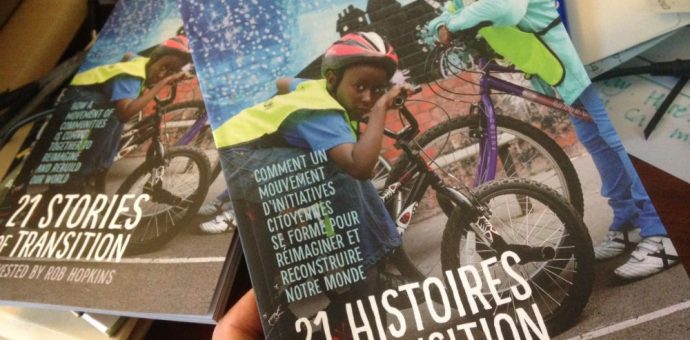
Well now, the historical pump has been primed. Everything has led up to this moment, isn’t it obvious? Right now, here in Totnes, as in other successful Transition Initiatives, people are ready to roll up their sleeves and get to work. As Rob in his new book, and others, suggest, it is time to make economic change the priority. It’s time to invest that valuable social and community capital into new economic structures, new green and social enterprises, to accelerate the pace of unplugging from the global corporate system.

There are models already out there, Transition Companion includes several. Caroline suggests in her post the other day that folks in Vermont are a little farther along. In my role as cultural cross pollinator, I suggest there are two other US models that have also made good progress and should be gleaned for what can be adapted, here. First, there’s BALLE, Business Alliance for Local Living Economies. It’s like Transition for locally owned businesses and pre-dates Transition by a few years. By engaging local businesses and local civic leaders, BALLE groups have managed to block “big box” retail developments, develop strong “buy local” preferences in their towns, not only relocalising their economies, but greening them, too.

Another good model is the Green Festivals which launched in 2001 in San Francisco. Founded by Global Exchange and Green America, which publishes a national directory of screened, socially and environmentally responsible businesses, Green Festivals was designed to begin building a green economy as an alternative to default capitalism. The first festival was very alternative – hemp, patchouli, chai – and just a little bit on green building. It provided a viable marketplace, a venue for speakers, music, organic and vegan food. It is really fun and effective. As a result, it has blossomed into an important enabler and cultural landmark in the budding green economy. Its success has demonstrated the viability of green business and economics and has attracted conventional businesses in ways that other forms of engagement could not have done. 

These examples illustrate two pathways: One is to begin creating the alternatives. The other is to engage and reshape existing economic structures. Philosophically, they are distinct approaches to change and may spark lively debates about which is the wiser path. However they’re not mutually exclusive.

Here in Totnes, the needs are apparent and many provide opportunities for new business formation. We’re working both pathways, but our situation demands more new alternatives. There aren’t enough jobs. There’s no local bank. Lots of energy retrofitting needs to be done and renewable energy generated. Most goods for sale on the high street or industrial estate are produced far away some of which are toxic and wasteful. Public transport is insufficient. There’s much more and I haven’t even mentioned the food system. 

There is much work to do, but we seem poised for making big progress over the next year.  Our Business & Livelihoods group began planning an incubator several months ago. If our plans come to fruition, it will become a focal point for rebooting the local economy, spawning new, green enterprises, new thinking, new energy. The aim is to provide inexpensive office space and other resources, mentoring, educational workshops, conferences, peer networking, and access to key contributors, expert and investors. As a part of the REconomy project, we hope it will also be a replicable model. But we’re several months away from launching and have a few obstacles to overcome. 

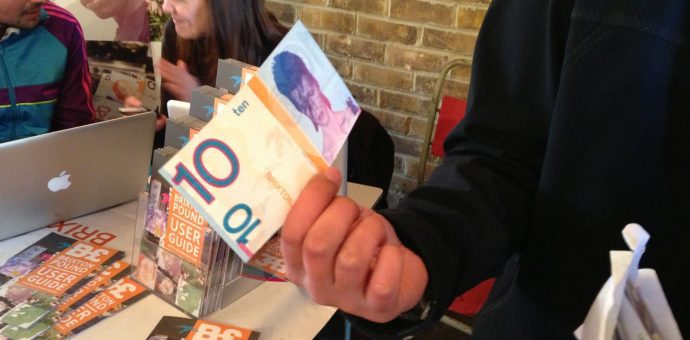
There are other projects contributing to change here, too, and many dreams waiting to manifest. The Totnes Pound is gearing up for a re-launch, coupled with an electronic system through a local credit union, which will hopefully be the start of a viable local banking system.  TRESOC, the community-owned renewable energy company recently completed a share offering to invest in a range of local, renewable energy projects.  Bob the Bus is looking to expand, too.  The electric bicycle sharing scheme is on the drawing board.  As are the community-owned brewery, youth hostel, alternative news weekly, home energy retrofitters, Transition café, market town permaculture guild, green DIY shop, and a local manufacturing outpost for the Global Village Construction Set.

All right friends, enough talk.  Let’s get to work.

Photos:  Occupier – David Shankbone, Creative Commons; artful cardboard house from Emma's The Big Draw project; BALLE logo; our local credit union; the Totnes Pound.

Comments

Charlotte Du Cann's picture

nice work if you can get it

Ace post Jay! I really enjoyed the linkage between the big picture thinking (Occupy) and the small town actions (Transition).

Do you have any good green business advice for us out-of-work writers in a localised economy? All suggestions welcome.

Best wishes from the East,

Charlotte

Jay Tompt's picture

Let's start something up!

How about we start something?  The Transition Free Press or TransitionNow! ala Amy Goodman.  Hmmm.  There was once something down this way called the Sherrack, an alternative monthly (http://alternativetotnes.wordpress.com/tag/alternative-press/) Sherrack means "shake it up" in old Devonish.  Maybe that's just the thing to resurrect?  Form a coop, issue shares - it could work.  There's also bringing a typewriter out to the market selling poems for a pound. 

Cheers,

jay

Charlotte Du Cann's picture

Thanks for those suggestions

Thanks for those suggestions Jay. I'm game! And I like that Free Press title a lot.

I've been talking with Mike Grenville (ed of the Transition Newsletter and our guest ed tomorrow) about starting up a national Transition paper, with regional and international eds. How to fund it of course is the big issue (sic). Can you have sustainable advertising?

How would issue shares work do you suppose?

All ideas welcome.

All the best,

Charlotte


Marella Fyffe's picture

This is an interesting conversation

  Jumping up and down from a distance ... this is interesting what you two are talking about.....a dear friend pointed out to me just last week , that I had done precisely one hours paid work in the whole week....the rest of the time was very successfully filled with Transition and other stuff... not wanting/able  to take on any more volunteering, but excited about the possibilities.

Caroline Jackson's picture

Like the idea of a Transition

Like the idea of a Transition paper.  We did our own Transition Times free paper in Lancaster, with lottery money in 2010.  Editor found the level of work very difficult and intense, needing to alter, amend, rewrite, shorten for the demands of the paper meant some hurt feelings! Printed ok, looked great but our distributor took the money and ran - only delivered a tiny % of 1500 copies.  We have talked about another edition but ... How about a Transition national with local centre page(s)? 

Charlotte Du Cann's picture

don't mess with my copy!

Yeah, everyone gets mad when they get cut (me too!). The way you get round this is to have a strong design and give good word counts. As for lolly, I reckon everyone should get paid -editors, designers, writers. The how is the next step . . . and find a secure distribution system. Yours on a deadline, Charlotte

Jay Tompt's picture

As Amory Lovins says,

As Amory Lovins says, sometimes the best way to solve a problem is to make bigger.  Hence, I like the idea of doing something on a national scale - might be easier.  This may be a project that REconomy could help bring to fruition.  BTW, I'm heading here on Thursday: http://www.good-dealsuk.com/index.php/programme/  Perhaps I will learn more there, then we can take this conversation in a new direction.

Cheerio!