Skip to Main Content

Derby, beneath us, around us and yet to be ?

Standing on the dark slate tomb of some long-forgotten eighteenth-century family, (children dead in infancy, parents living no more than 30 or 40 years), our bright red and stainless steel community apple press looked, even to us, a little…well…."incongruous”.

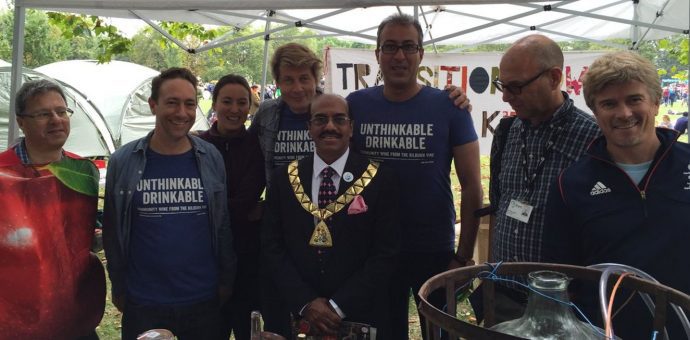
three children by the brightly coloured apple pressFrom a portable wood-burning stove to our left, another community group was serving delicious home-made soup - and lively music was emanating from brightly clad musicians in a portable gazebo structure over the graves of some plague or epidemic victims on our left. The old stone walls were brightened with banners and messages inviting and welcoming the living. So, there we were:  a Transition town group at a lively food festival in the middle of Derby, crushing apples in a churchyard, making delicious juice and serving it to passers by in the sunshine of an autumn Saturday.  Our location didn’t seem to worry anyone – right in the centre of Derby’s shopping district: Anglicans these days are committed to “shrinking the carbon footprint” and there was nothing sacrilegious about it. In fact, I suspect that the inhabitants of the graves beneath us would have recognised a lot of what we were doing. They might have enjoyed the food and drink on offer. They might have shared our harvest-time appreciation of local, organic food - or as they might call it, “food”.

They held similar events themselves - and possibly even in the same place since churches have long been focal points for whole communities in a way that they rarely still are today. But, what if stepping out of the churchyard, right in the centre of Derby, our visitors from the past had looked across the pedestrianised road in front of us, what would they recognise there ?

The large BHS store, directly opposite the churchyard, would not escape their notice  -  then the rest of the brash 21st century shopping mall in which it sits, would meet their eyes. I think, though, that they might also look at the people going past and marvel at their clothes, their electronic gadgets, their sheer numbers, their vast material wealth (by any previous generation’s standards): even the “poor” ones, apparently  “better off” than the poor of their own day. And if our visitors spoke to the people going by : how might the attitudes and any exTransition network gazebo by an old wallistential angst that they found, contrast with that of their own times ?

We Transition Town apple-pressers of today sometimes try to  “Re-imagine the High Street”.  We are not, however, trying to put ourselves in the position of those rising from the graves beneath our feet a few hundred years back.  I’m not even sure if we are trying to imagine something as it might look even just a few years from now as global resource depletion really begins to bite.  Rather, in our “re-imaginings” we want to better understand the processes of change – and in  doing so, maybewe can hope to influence those processes positively.  And there’s the problem that I keep running into.

I’ve been involved in several such reimagining sessions now –  including one at the New Economics Foundation earlier this year, and another during the REconomy day at the 2012 Transition Network conference. I’m the type of person who hasn’t got a lot of time for anything I consider to be impractical or unrealistic, over-simplified, simplistic or just too cosy and “fluffy”.  “Re-imagine the High Street”  by all means, but if we don’t set the context and objectives for these exercises carefully, we tend  to end up with visions that seem to involve 23 independent vegetarian cafés, several yoga and similar establishments, a couple of tailors, a bakery or two, a holistic health centre, an organic veg shop, an organic brewery, and a Steiner school perhaps. I exaggerate, but we’re lucky if anyone identifies where the energy for these High Streets comes from, how sewage is collected and disposed of, how fresh water is provided, where or how the dead are buried, where things are made that the local community cannot resource for itself and how inter-community trade is conducted.

Banner saying Real food Fair plus young ladIf you acknowledge this point of view, the most valuable “imagining “ exercises are those which are bound by some likely or realistic constraints.   it is not enough for Transitioners to imagine some mythical post-consumerist future where everyone is vegan and no-one has any significant impact on planetary resources. Much more valuable is to “get real” about the scenarios we can expect - much like many businesses and organisations do, in fact. Check out Shell’s public version of its scenario planning for example: but don’t forget whose scenarios you are reading !

If we at least acknowledge Maslow’s hierarchy of human needs and also try to take a “whole “systems approach, then the Transition “High Street” exercise begins to provide some genuine insight into economic and social change in light of the big global drivers. Imagining and modelling the changes we can expect is far more difficult but it becomes a whole lot more useful as a result. There is another key question too.  Given the precarious vulnerability of all economies to sudden disruptions to oil and food supply, should we be exploring the “disaster” scenarios as well as the hoped for ideal of a smooth Transition ?  Disasters, as our forebears knew, and we easily forget in our generally fossil-oil enabled comfortable lives - happen.

I’m here in Derby, standing on a slate dark tomb imagining a sustainable future, getting out there, making a difference with our apple press, but what will we really have to go through on our high street – and how can - or should - we prepare for that ?

Pictures: all Derby Real Food Fair (Graham Truscott)

Graham Truscott is an occasional guest blogger with a background in publishing and working for international corporations including IMI plc and Rolls Royce before coming to the Transition Network as a practitioner with Transition Training and Consulting. Involved in launching the Derby Carbon Initiative and developing carbon-neutral energy technology businesses like Air Fuel Synthesis. Founder member of the Reconomy project.

Comments

Caroline Jackson's picture

Re-imagining the High Street

Thanks for this blog Graham which stands as a bit of a challenge to the "romantic" transitioning model that I alluded to yesterday, where somehow we "all pull together" and the infrastructure  necessary to our continued reasonably comfortable  existence just comes into being.   I wouild like to get invplved in what you described as "valuable imagining  exercises ... bound by some likely or realistic constraints" - is there anyone or anywhere that is doing work like this?

Transition has  always avoided the gloom and paralysis associated with those who pedal the "doomed, doomed" view of the future, however I don't see that, that requires us to close our eyes to specific and possible disasters.  If we want resilience we need to know what might completely upset the operating of our regions and be prepared to take a possible lead in dealing with the results of a disaster not to mention its longer term aftermath.

Graham Truscott's picture

Planning for disaster(s) ?

One of the most appealing features of the Transition Town network - especially for the terminally worried like me -  is its emphasis on positive opportunities amongst all the unpleasant exploitative things we see happening around us.

I'd love to sign up whole heartedly for the vision that we can solve the problems if only enough people in our society will see that people care, earth care and fair share make sense. My problem is that I can't shake off the very considerable doubt that we'll achieve this fundamental mindset change on sufficient scale before the big problems - financial, climate and resource depletion crises bite us really hard. When I look at littered streets, crowds of people in towns and cities, I wonder who is going to feed them all when the real crises hit. A few little vegetable patches, even one in every garden and community space, even if that could be achieved, won't do it.

Call it a nasty failure of my imagination or vision, or whatever you like, but I can't shake it off - and that's what sets me wondering if we shouldn't be thinking a bit more about likely scenarios and how we can live up to our ideals in those scenarios. It's not enough to consider only a smooth transition to the world we imagine,  because, on present trends, there isn't time for that to happen....


I don't know of anyone doing work in this area - though perhaps the government's COBRA group is ! I'd need a lot of inner transition help to tackle it myself !